When your training is coached, structured, and scaled to you, strength stops feeling like a grind and starts feeling like momentum.
If you have ever left a workout thinking, That was effective... but it did not wipe me out, you have already felt the difference between random effort and smart training. The best Fitness Classes are not about doing more and more. They are about doing the right things, in the right order, with the right coaching so your body learns quickly and you can repeat it next week.
In Maplewood, time is a real constraint. Work, commutes, family schedules, and the general hum of life can make fitness feel like one more job. Our goal is the opposite. We build Fitness Classes that make progress feel straightforward: show up, get coached, move well, leave stronger.
This article breaks down how our small group approach makes strength feel almost effortless, not because it is easy, but because it is clear, repeatable, and designed for real life.
Why “effortless” strength is usually about structure, not willpower
Most people do not struggle because they lack motivation. The struggle is usually decision fatigue: What should I do today, how hard should I go, and am I doing it right. When every session requires figuring it out from scratch, consistency gets shaky.
Our Fitness Classes remove that guessing. Each class follows a repeatable 60 minute framework that blends functional strength training, interval work, mobility, conditioning, and recovery. You get variety, but the variety is organized, so your body adapts rather than just survives.
That structure creates a very practical kind of confidence. You start to recognize movements, understand why we program them, and feel your control improve week to week. Strength becomes a skill you build, not a punishment you endure.
What “functional strength” actually means in our classes
Functional training can be a fuzzy phrase, so we keep it concrete. We train patterns that show up in daily life: squatting to get low, hinging to pick things up safely, pushing and pulling to support posture and shoulder health, and rotating or bracing to protect your back.
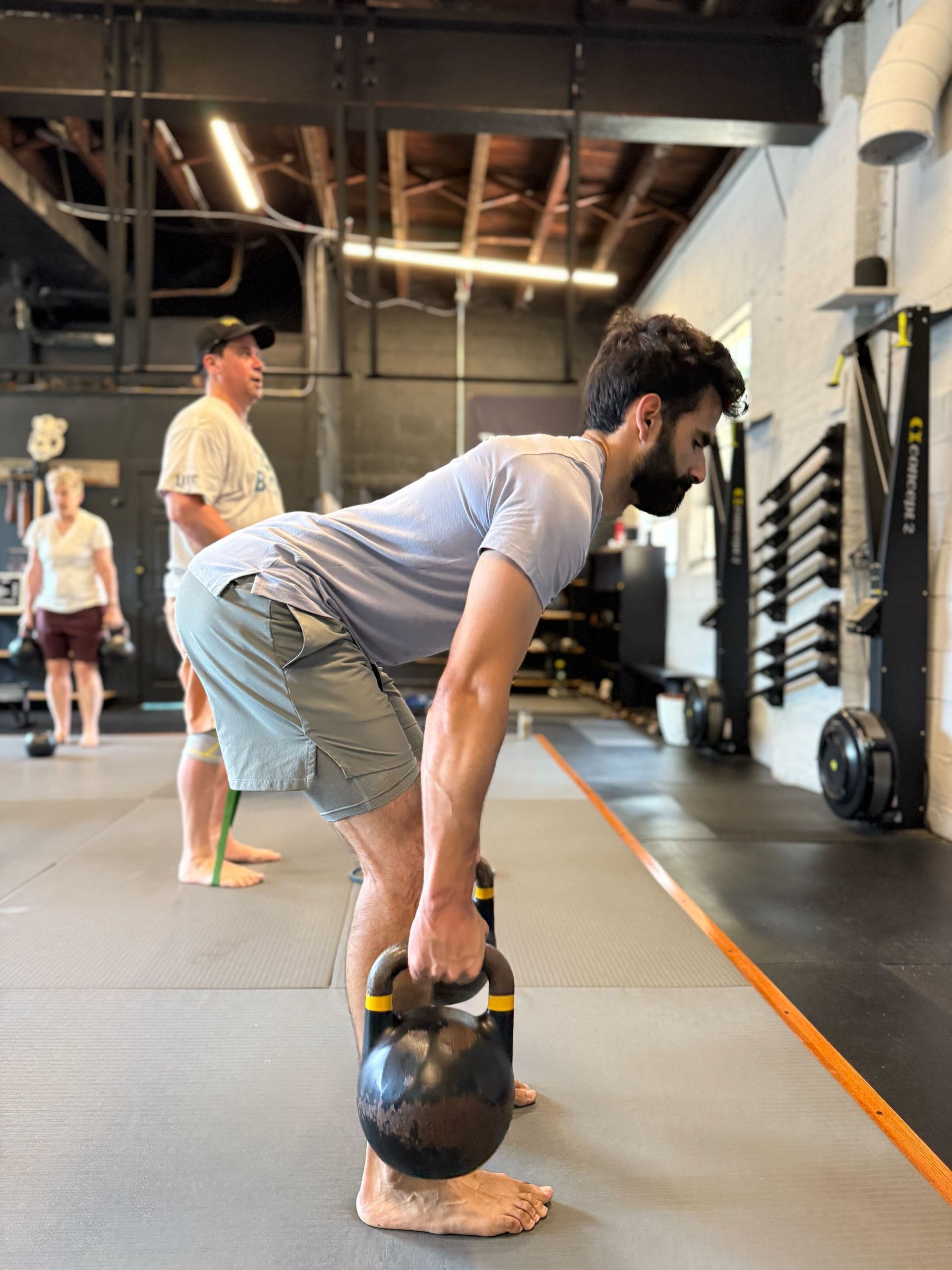
You will see staples like squats, deadlifts, push ups, rows, and kettlebell swings because these movements deliver a lot of return on your time. When coached well, they build strength, stamina, posture, balance, and resilience in ways that translate outside the studio.
And importantly, we focus on form first. Not “perfect form or nothing,” but honest, coached mechanics that keep you progressing without stacking up little aches. That is a big part of why getting stronger can feel effortless: your body is working with you, not fighting you.
The small group advantage: coaching that makes progress feel natural
In a crowded room, it is easy to hide, rush, or copy someone else’s pace. In small group Fitness Classes, we can actually see you move. That changes everything.
We coach details that matter, like your breathing during a hinge, your rib position during a press, or your foot pressure in a squat. Those tiny adjustments often create immediate wins: the movement feels smoother, the load feels more manageable, and the next rep looks cleaner.
Small groups also make it easier to meet you where you are. Some days you come in energized, some days you are dragging a bit. We can nudge intensity up or down while keeping the training intent intact, so you still leave feeling like you did something meaningful.
How we scale Fitness Classes for beginners and experienced members
A good class should not force you into one lane. Our approach is to keep the goal of the workout consistent while adjusting the route you take to get there. Scaling is not a downgrade. It is smart training.
Here are a few ways we scale in our Fitness Classes so every level gets what the session is designed to deliver:
• Range of motion adjustments so you can move well today, like box squats while you build depth and control
• Load changes that match your current strength, from bodyweight to dumbbells to kettlebells and beyond
• Tempo choices to build stability, like slower lowering phases when you need more control
• Complexity options that keep you safe, like a deadlift variation that supports a solid hinge pattern
• Volume tweaks for advanced athletes, adding sets or reps when technique stays crisp
This is how the same class can serve a brand new member and someone who has trained for years, without anyone feeling lost or held back.
The 60 minute format: enough time to build, not enough time to spiral
We keep classes to 60 minutes for a reason. It is long enough to warm up properly, lift with focus, and finish with conditioning and recovery. It is also short enough to fit into real schedules without turning training into an all evening affair.
A typical class includes a few consistent pieces:
A warm up that prepares your joints and nervous system
We use mobility, activation, and light movement to get your body ready for the main work. This is also where we reinforce breathing and positioning so you start the session organized, not rushed.
Strength work that teaches skill and builds capacity
Strength training is not just about going heavy. It is about repeatable, well coached reps that build the movement pattern. Over time, load increases naturally because your technique improves and your confidence grows.
Conditioning that supports performance without burnout
Intervals can be challenging, but we keep them purposeful. You should leave feeling worked, not wrecked. The goal is improved energy, better stamina on stairs, and a body that can handle life without feeling fragile.
Recovery that helps you actually come back stronger
We end with breathing, mobility, and downshifting. Recovery is not a luxury. It is part of the training effect, and it supports consistency, which is where results really come from.
Why mindfulness and breathing show up in strength training
Strength and mindfulness might sound like separate worlds, but they overlap more than people expect. When you learn to breathe under effort, stay present in a set, and notice tension patterns, your lifting gets safer and more effective.
We coach breathing because it helps with bracing, posture, and control. We coach intentional movement because it improves motor learning, which is a fancy way of saying your body learns the skill faster when reps are consistent and focused.
In practice, this often feels like calm strength. You finish a set and think, I can do hard things without getting frantic. That carries over into daily stress in a surprisingly useful way.
The “effortless” feeling is really community momentum
There is a quiet power in training alongside other people who are also showing up consistently. You do not need to be best friends with everyone in the room. Just seeing familiar faces, getting a nod from a coach, and sharing the rhythm of a session makes it easier to return.
Our environment is supportive and non judgmental, which matters more than most people admit. When you feel safe to be new at something, you learn faster. When you feel encouraged, you push a little more. When you feel seen, you come back.
That is one reason Fitness Classes in Maplewood NJ can be such a strong fit for busy adults: community turns workouts into something you do, not something you debate.
What results you can expect if you stay consistent
We avoid promising dramatic overnight transformations because that is not how real training works. What you can expect, if you show up and let us coach you, is steady, noticeable progress.
Most members report changes that are both measurable and practical:
• Strength gains in foundational lifts and bodyweight control
• Better stamina for everyday tasks, like carrying groceries or moving quickly up stairs
• Improved posture and fewer “tight” feelings from sitting or commuting
• More confidence with movement, especially with bending, lifting, and bracing
• A clearer routine that supports discipline without taking over your week
The biggest shift is often this: your baseline energy improves. You stop feeling like fitness drains you, and you start feeling like it feeds the rest of your life.
How to make Fitness Classes work even when your schedule is packed
Consistency is not about being perfect. It is about reducing friction. We recommend starting with a realistic frequency and building from there.
A simple approach that works well:
1. Pick two days you can protect most weeks, even if the times vary a little
2. Treat class like an appointment, not a maybe
3. Track one small weekly win, like smoother squats or less winded stair climbs
4. Ask us for a scale option when life is heavy, so you keep the habit
5. Add a third day only when two days feels automatic
This is exactly how strength becomes “effortless.” Not because effort disappears, but because the routine stops feeling complicated.
Take the Next Step
Building strength that fits your life takes more than motivation. It takes a plan, coaching, and a room where you can practice consistently without overthinking it. That is what we deliver every day at Soma MVMT, right here in Maplewood: small group sessions that blend functional strength, conditioning, mobility, and recovery in a repeatable 60 minute format.
If you want Fitness Classes in Maplewood NJ that feel organized, supportive, and genuinely sustainable, we would love to have you join us for a free trial class at Soma MVMT and experience the difference for yourself.
Build strength, endurance, and mobility by joining a fitness class at Soma MVMT.